Book summary
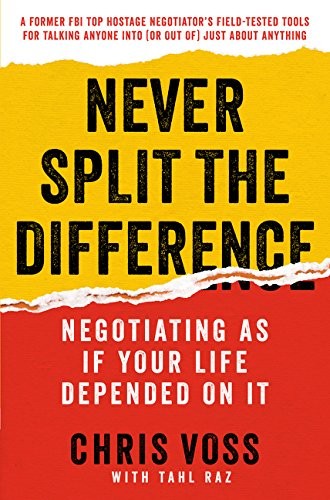
Never Split the Difference
Negotiation tactics rooted in empathy and tactical listening.
Summary
Negotiation is often misunderstood as a battle of logic where two rational parties meet in the middle. In his book Never Split the Difference, former FBI lead international kidnapping negotiator Chris Voss dismantles this myth. Drawing on his experience in life-or-death crises, Voss argues that the traditional advice to compromise is flawed. Instead of a cold exchange of logic, negotiation is an emotional game played by irrational humans. To succeed, you must abandon the idea of ‘win-win’ compromises and master the art of tactical empathy, active listening, and psychological influence.
The New Rules: Emotion Over Logic
Traditional negotiation theory suggests that logic should dictate outcomes, but Voss found this approach fails in the real world. Humans are not rational calculators. They are emotional, unpredictable, and driven by psychological needs first and logic second. Trying to force a logical compromise ignores the human element.
Voss posits that compromise is usually a failure. When you split the difference, both sides often leave the table unhappy because they gave up something they wanted. True breakthroughs come not from meeting in the middle, but from discovery. You must treat negotiation as a process of uncovering what really drives the other side. This requires looking beyond the surface to understand the hidden fears, desires, and constraints that govern their behavior.
Be a Mirror to Build Trust
The first tool in the tactical empathy arsenal is mirroring. This technique involves repeating the last one to three words your counterpart just said, but with an upward inflection. It might feel awkward or simple, but it is incredibly effective.
Mirroring works because it triggers a basic human desire to be understood. When you mirror someone, it signals that you are paying attention. Almost instinctively, the other person will elaborate on their statement to clarify what they said. This keeps them talking and reveals more information than they intended. The key to mirroring is patience. After you repeat the words, you must remain silent. Let the silence do the heavy lifting. Do not interrupt. The discomfort of the silence will compel them to fill the void, often providing crucial insights or concessions.
Don’t Feel Their Pain, Label It
While mirroring encourages speech, labeling helps manage the emotional climate. Many people try to empathize by saying ‘I know how you feel,’ but this can backfire because you cannot actually know how they feel. Instead, Voss recommends labeling emotions.
Labeling is the act of identifying a feeling or dynamic and putting a name to it. You start with phrases like ‘It seems like…’ or ‘It sounds like…’ followed by the emotion you detect. For example, ‘It seems like you are frustrated with the timeline.’
This tactic is powerful because it validates the other person’s emotions without you having to agree with them. When a negative emotion is labeled, its intensity diminishes. By acknowledging their feelings, you create a space for collaboration. People relax when they feel heard and understood without judgment. This transforms tension into trust, allowing you to guide the conversation toward a solution.
The Power of ‘No’ and ‘That’s Right’
Conventional wisdom tells us to get a ‘yes’ as quickly as possible. Voss argues that ‘yes’ is often useless. In the face of pressure, people say ‘yes’ just to make the conversation stop, to be polite, or to escape the situation. A ‘yes’ without substance is counterfeit.
The real start of a negotiation is a ‘no.’ ‘No’ makes people feel safe and in control. It protects them from making a commitment they do not want. Therefore, you should ask questions that are designed to elicit a ‘no,’ such as ‘Is now a bad time to talk?’ or ‘Have you given up on this project?’ This gives the counterpart the illusion of control and opens the door for honest dialogue.
Ultimately, however, you are striving for a different phrase: ‘That’s right.’ ‘You’re right’ is often a dismissal, a way for someone to end the conversation without agreeing. ‘That’s right,’ on the other hand, signals a breakthrough. It means the other side feels you truly understand their situation. You reach this moment by summarizing their perspective and fears until they tell you that you have got it exactly right.
Shape Perception with Anchors
When it comes to numbers, Voss emphasizes that people respond to context and framing, not just raw data. One effective tactic is to use extreme anchors. By making a bold first offer or using an unexpectedly low number, you reset the other person’s expectations and shift the range of the negotiation in your favor.
Human psychology is also heavily biased toward loss aversion. People fear losing more than they desire winning. Therefore, you should frame your concessions as painful sacrifices. Let the other side feel that the negotiation is difficult and that they are winning against a stubborn opponent. This makes the final deal feel more valuable to them.
Additionally, Voss suggests using odd, precise numbers instead of round figures. An offer of $51,500 feels like it was calculated with care and research, whereas $50,000 feels like a rough estimate. Precision lends credibility to your offer and makes it harder for the other side to dispute.
Guarantee Execution and Find the Black Swan
A deal is only good if it is executed. To ensure the other side follows through, you must guard against vague promises. You can use calibrated questions-questions that start with ‘how’ or ‘what’-to force the other side to solve the problem of compliance. Asking ‘How will we know we are on track?’ makes them outline the steps for success, creating accountability. Listen for hesitation in their answers, as this signals weak commitment.
Finally, Voss introduces the concept of the ‘Black Swan.’ These are hidden pieces of information that, once revealed, can completely change the course of the negotiation. There are always things you do not know. To find them, you must stay curious and observe inconsistencies between a counterpart’s words and their behavior. Every negotiation hides unknowns, and finding them is the key to unlocking value that no one else saw.