This past week, I got my first real taste of flying a small aircraft.
My uncle took me up from Harvey Airfield, up to Arlington Municipal Airport, over to Paine Field, east toward Stevens Pass, and then back to Harvey. It was a familiar part of Washington seen from a completely unfamiliar perspective.
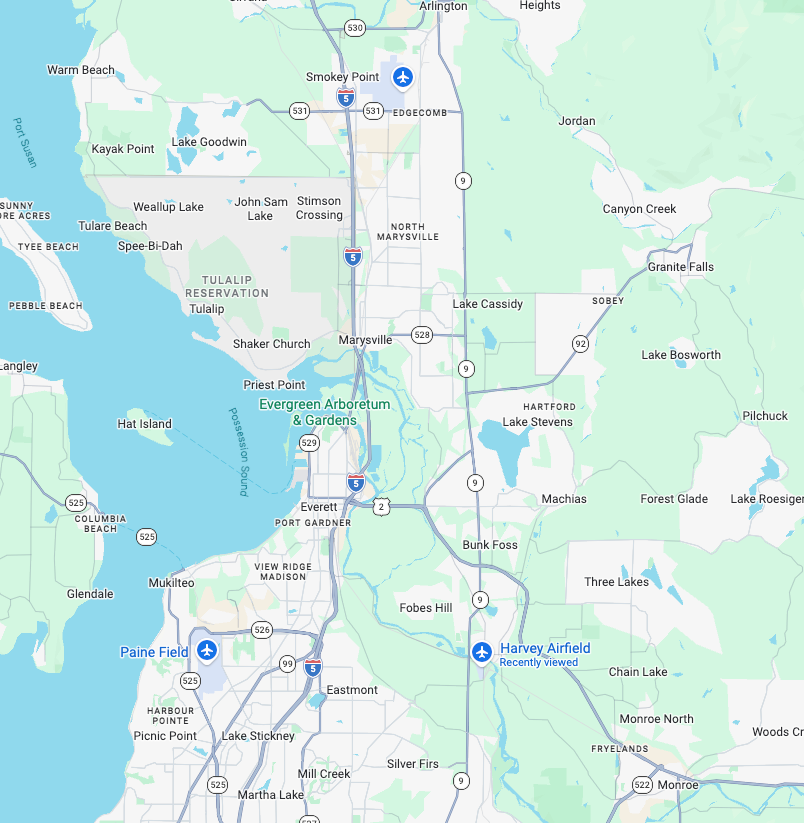
The airports that shaped our route through western Washington.
Learning How an Airplane Feels
The first surprise was how the aircraft moved. It felt a little like being on a boat. The plane was never simply fixed in place; it responded to the air around it, and I had to make small corrections instead of expecting it to travel as if it were on rails.
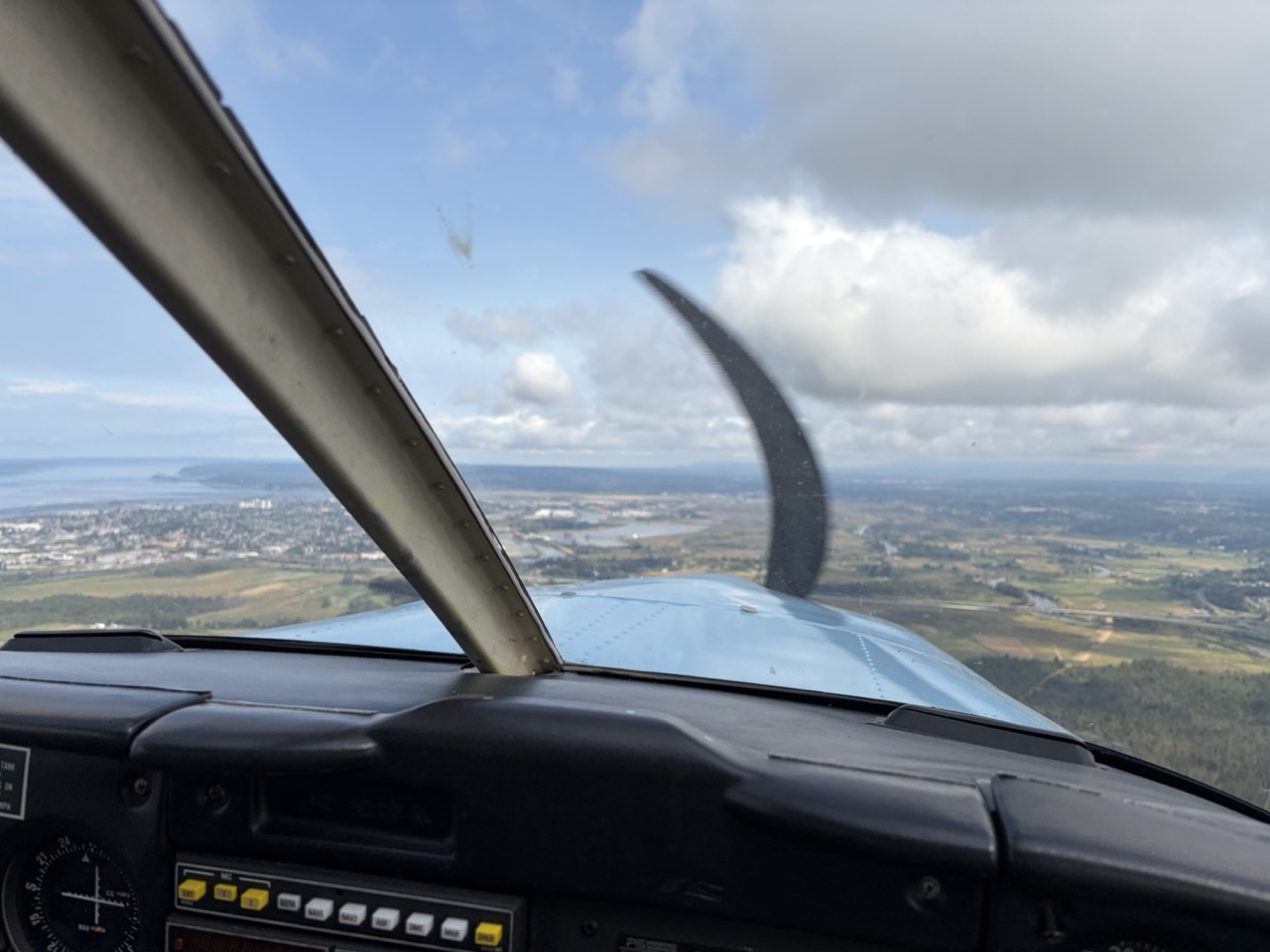
The view from the cockpit as familiar roads and towns became navigation references.
I practiced keeping our altitude and steering in a consistent direction. One of the simplest and most useful techniques was to choose an object far away and keep the airplane pointed toward it. Looking into the distance made it much easier to hold a direction than focusing too closely on the controls or the ground below.
We also used I-5 and Highway 2 to orient ourselves. Roads I normally experience from a car became navigation references from above. That change in perspective was one of my favorite parts of the flight: the landscape stopped being a sequence of exits and intersections and became one connected map.
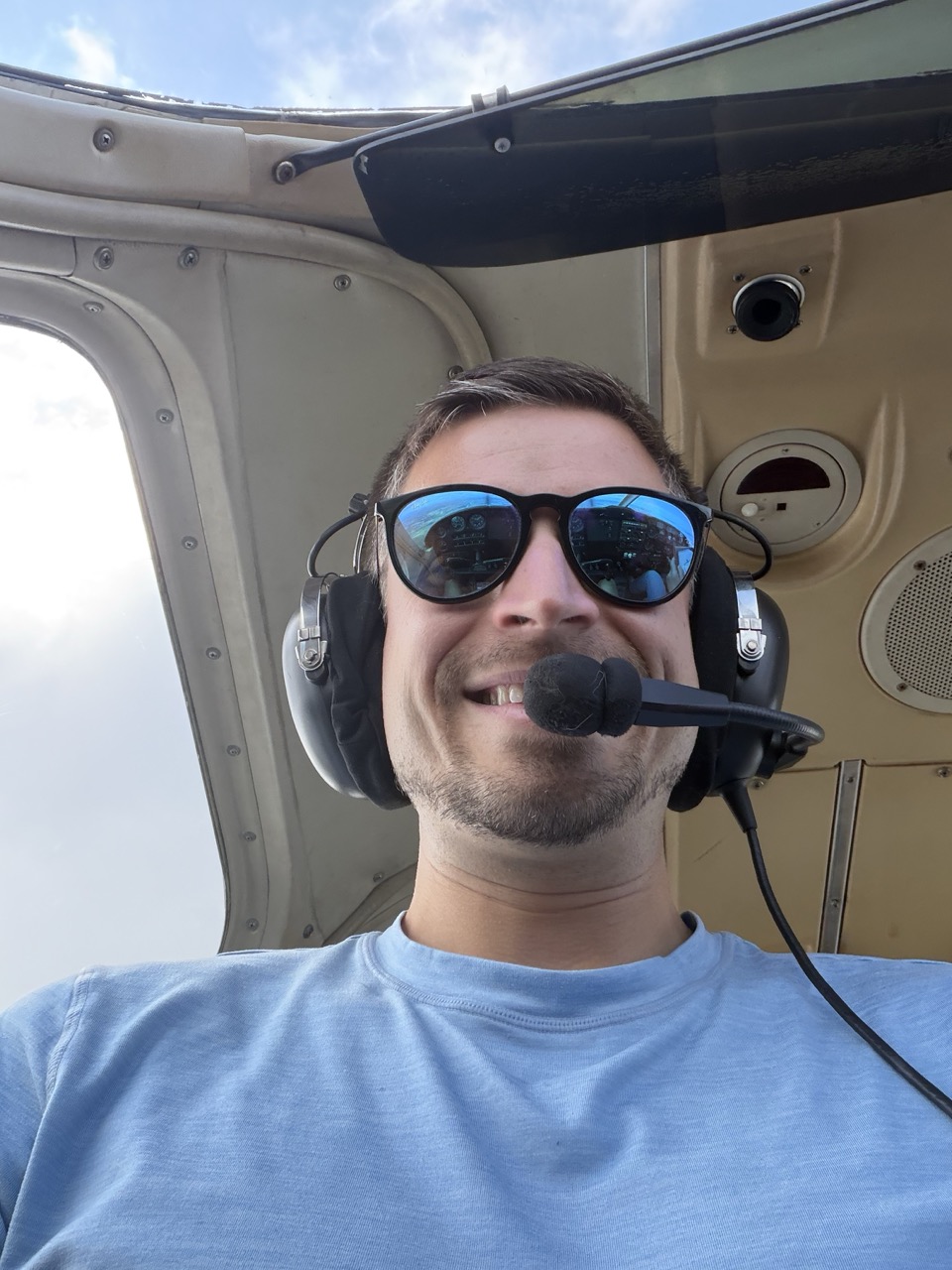
Headset on and taking in a completely new environment.
My First Maneuvers
With my uncle—an airline transport pilot and authorized flight instructor—remaining pilot in command and closely supervising me, I briefly handled the controls. I practiced holding altitude, maintaining direction, and making three gentle 180-degree turns while he was ready to take over. They were basic maneuvers, but they required more concentration than I expected. I had to think about the turn, maintain altitude, watch where we were going, and keep my movements controlled—all at the same time.
That combination made flying feel very different from driving. In a car, the road defines most of your movement. In the air, the freedom is much greater, but so is the need to stay aware of your direction, altitude, and surroundings.
My uncle also bought me a flight log and entered this first flight as maneuvers. Because he was acting as my authorized instructor, he explained that this logged training time can count toward the 250 total flight hours required on the path to an airplane commercial pilot certificate. Seeing the entry on paper made the whole experience feel real. It was no longer only an idea or something on my roadmap to becoming a pilot. I now had a first flight in my own logbook.
The Less Glamorous Part
It was not all effortless freedom. The cockpit got really hot, and at one point I became a bit nauseous. Between the heat, the movement, and the concentration, my body was clearly working hard to adjust to a new environment.
That did not take away from the experience, though. If anything, it made the flight feel more honest. Flying is incredible, but it is also physical. There are sensations and limits that I will need to understand and learn to manage.
A World of Its Own
What stayed with me most was the feeling that aviation is its own world. It has its own metrics, measures, directions, language, and way of seeing the landscape. Altitude matters. Heading matters. Distant objects and major roads become tools. Even a simple turn asks for coordination and attention.
And yet, inside all those systems and measurements, I felt a kind of freedom that is hard to find on the ground.
This was only my first small-aircraft flight session, and I still have an enormous amount to learn. But the goal of becoming a pilot now feels less abstract. There is a first entry in my flight log, a few maneuvers behind me, and a much clearer sense of why I want to keep going.